
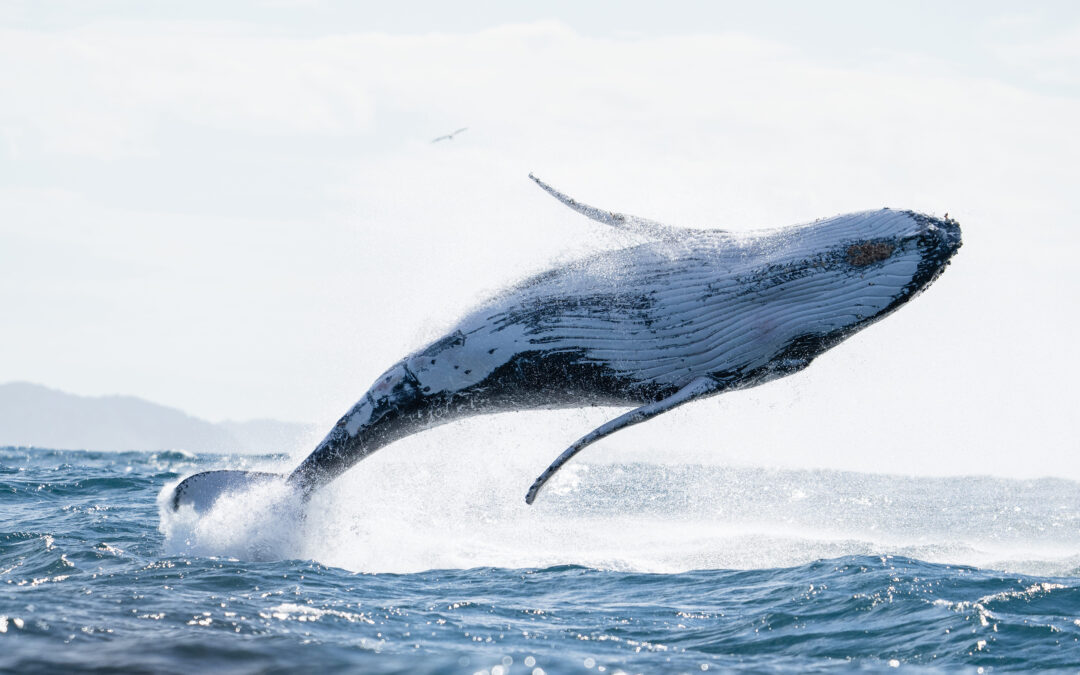
Whale watching from Norries Headland is one of the best free, land-based ways to see humpback whales on the Tweed Coast, with the elevated headland lookout putting you above the migration corridor from June through October. The walk from our apartments takes five minutes, the vantage point sits roughly 30 metres above the water, and on a clear August morning you can track spouts and breaches without spending a dollar on a boat.
What makes Norries Headland a standout whale watching spot?
The geography does the work. Norries Headland juts out from the northern end of Cabarita Beach, pushing you out over the water rather than leaving you standing on a flat beach squinting at the horizon. The lookout sits at the high point of the headland walk, and from there you get an unbroken sweep from Hastings Point in the south around to the hinterland ridgeline behind Cabarita.
Humpback whales migrate along the continental shelf, and the Tweed Coast section of the shelf runs close to shore. That matters because it means the whales pass within a few hundred metres of the headland rather than kilometres out. On calm mornings, you can hear the blow before you see it. The sound carries across glassy water in a way that catches you off guard the first time.
The headland is part of the Norries Head walk, a loop track that starts near the Cabarita Beach rock pool and climbs through coastal scrub to the lookout. The walk takes about 15 minutes at a strolling pace, and most of it is graded path. It is not a hike. You can do it in sandals with a takeaway coffee, and we send guests up there most mornings in winter.
When do humpback whales pass Cabarita Beach?
The short answer is June to October, but the shape of the season matters more than the dates.
The northern migration runs from roughly late May through July. These are the whales heading from Antarctic feeding grounds up to the warm waters off Queensland to breed and calve. They travel fast, often in small groups or pairs, and you see a lot of spout-and-dive sequences without much surface drama. July is when the numbers peak on the northbound leg.
August and September are when the watching gets genuinely spectacular. The first southbound whales start appearing, and these are the ones in less of a hurry. Mothers with newborn calves hug the coastline on the return south, staying in shallower water where the calves can rest and feed. They move slowly, surface frequently, and the calves breach constantly because they are learning how their bodies work. If you are planning a trip specifically around whale season, August is the month we recommend.
By October the tail end of the migration passes through. Numbers thin out, but the late-season whales tend to be mothers with older calves, and the calves are big enough to put on a proper show. The season does not end with a hard cut-off; it fades out over a few weeks.
What should you look for from the headland?
The first thing to train your eye on is the blow. A humpback’s exhale produces a bushy, V-shaped spout that sits on the water surface for a few seconds before the wind takes it. On a still morning, you can spot a blow from over a kilometre away. Once you have seen one, your brain starts picking them out automatically.
After the blow, watch for the back rolling through the surface. Humpbacks have a distinctive dark, rounded back with a small dorsal fin set about two-thirds along. When a whale is travelling, you see the blow, then the back, then the tail stock, and sometimes the fluke as it sounds for a deeper dive.
Breaching is the crowd-pleaser. A full breach is a 30-tonne animal launching most of its body out of the water and landing on its back or side. The splash is enormous and visible from a long way off. Calves breach more often than adults, and during August and September you can sometimes watch a calf breach repeatedly while its mother cruises along nearby.
Pectoral fin slapping is another one to watch for. Humpbacks have the longest pectoral fins of any whale, and they roll onto their sides and slap the fins on the surface. The sound carries across the water like a distant gunshot.
How do you set up a good morning on the headland?
Get there early. The best whale watching conditions are flat, glassy seas with minimal wind, and on the Tweed Coast that usually means before 8am in winter. The morning light sits behind you when you face east from the headland, which cuts the glare and makes spouts easier to spot against the dark water.
Bring binoculars if you have them. A pair of 8x42s is ideal because they gather enough light to work in low morning light and have a wide enough field of view to scan the horizon. You do not need marine-grade optics. Any compact pair from a camping store will improve the experience dramatically.
A light jacket or fleece layer is worth throwing on even if the forecast says 20 degrees. The headland catches the breeze, and you will be standing still for 30 to 60 minutes. Coffee from the village helps. Layers and coffee are the unofficial uniform.
We suggest allowing at least 45 minutes on the headland. Whale watching rewards patience. You might see a blow within five minutes, or you might wait 20 minutes and then have three whales surface at once. The unpredictability is part of what makes it different from a scheduled boat tour.
Is land-based whale watching worth it compared to a boat?
A boat tour gets you closer, and there is no substitute for having a humpback surface 50 metres from the hull. But land-based watching from Norries Headland has genuine advantages that are easy to underestimate.
The elevated angle from the headland lets you see whales in context. You track them travelling along the coast, spot pods at different distances, and watch the calves playing while the mothers feed. On a boat, your horizon is at water level and your view is whatever is immediately around you.
There is no seasickness, no fuel cost, no booking window, and no minimum group size. You walk up, watch, and walk home. If conditions are flat, you can go back the next morning and the morning after that. Guests staying with us for a week in August routinely do three or four headland mornings and see whales on most of them.
For families with younger children, the headland is far more practical than a two-hour boat charter. Kids lose interest in structured tours, but a morning that starts with breakfast in the apartment, a short walk to the headland, and a spout-spotting game tends to hold their attention long enough for a genuine sighting.
The property sits right at the southern end of Cabarita Beach, so the headland walk starts essentially from the front door. That proximity is what makes the land-based option so appealing from our apartments. You are not driving 40 minutes to a departure point; you are walking five minutes with a coffee.
FAQs
When is the best time of year to see whales from Norries Headland?
The humpback migration passes Norries Headland from June through October. July to September is peak season for the northern migration, and late September into October brings mothers with calves on the return south, often closer to shore.
Do I need binoculars for whale watching at Cabarita Beach?
Binoculars help for picking out distant spouts and tracking a whale between breaches, but during peak season you can spot blows and surface activity with the naked eye. A pair of 8x42s makes the morning noticeably better.
How far is Norries Headland from The Beach Cabarita?
Norries Headland is roughly a five-minute walk north from the apartments. Follow the beach path past the rock pool and up onto the headland track. You can be at the lookout before your coffee goes cold.
Is Norries Headland suitable for kids?
The headland walk is short and mostly graded, though the final lookout section is unfenced and elevated. Keep younger children close to the path edge. Kids tend to love the spout-spotting game once they know what to look for.
Can I see whales from Cabarita Beach itself?
You can spot spouts and breaches from the beach, particularly on calm mornings. The headland gives you the elevated angle that makes it easier to track movement and see whales further out, so it is worth the walk up.
If you are planning a Tweed Coast stay around whale season, August and September put you right in the middle of the migration with Norries Headland five minutes from the apartment. Check availability at The Beach Cabarita and make the headland your morning routine.
Image credit: Visit the Tweed